
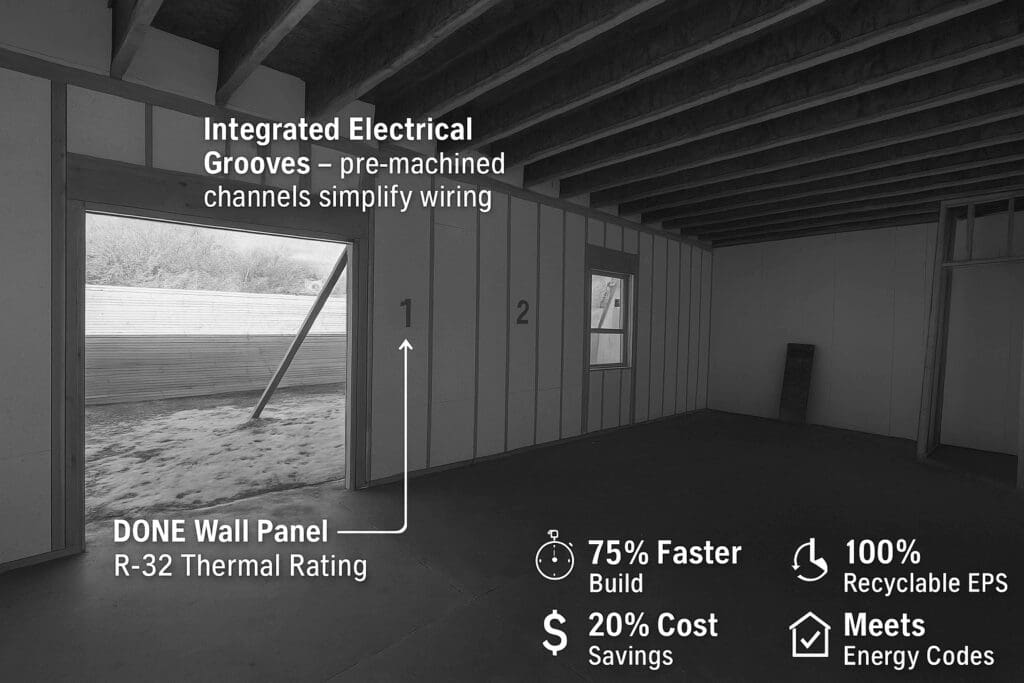
As we conclude our 2026-focused series, the final question builders and investors must ask is: how can I gain a sustainable competitive edge in an increasingly complex construction market?
Labor shortages, rising wages, tighter energy codes, and growing customer expectations have created a market where traditional construction methods are becoming riskier and less profitable. Integrated insulated building systems — which combine foundation, structural elements, insulation, and sometimes finishing components into a pre-engineered package — offer a strategic advantage that addresses all these pressures simultaneously.
By adopting integrated systems, builders can accelerate timelines, reduce labor dependency, ensure compliance, improve quality, and ultimately differentiate in a crowded marketplace. For investors, these systems represent a scalable, high-leverage opportunity in a market projected to grow steadily over the next decade.
Builders in 2026 face multiple pressures:
Traditional construction methods — framing, insulation, and finish performed by multiple trades — amplify these risks. Builders juggling multiple vendors, scheduling conflicts, and quality control challenges are left vulnerable to delays, rework, and margin erosion.
Integrated systems reduce the number of trades required, consolidating multiple steps into a single pre-engineered package. For example:
By minimizing hand-offs and dependencies, builders reduce the risk of errors, accelerate schedules, and lower total labor costs.
Studies suggest that integrated insulated building systems can shorten project timelines by 15–30% compared to conventional methods, depending on project complexity. Shorter timelines translate to:
Integrated systems are engineered for consistent performance. Fewer interfaces and factory-assembled components reduce thermal bridging, air leaks, and moisture infiltration — critical for meeting 2026 energy codes. Reduced rework also lowers labor costs and warranty exposure, strengthening a builder’s reputation.
With energy codes tightening nationwide, integrated systems provide a built-in advantage for compliance. Pre-assembled insulation and envelope systems simplify inspections, testing, and documentation. Builders can provide regulators with verifiable performance data, reducing approval delays.
Builders who deliver higher-performance, faster-to-market structures gain a competitive edge in multiple ways:
Integrated systems create repeatable installation processes for builders. Once adopted, they standardize workflows, creating recurring revenue for manufacturers and distributors. Higher builder retention translates to predictable sales and higher lifetime value.
Builders adopting integrated systems in 2026 gain experience, scale, and standard operating procedures before competitors. Investors who back companies at this stage capture first-mover advantage in a market with growing adoption.
Builders standardizing on integrated systems face training, workflow, and logistical investments. Switching to another method or product incurs cost and risk, creating a barrier to competition.
Using integrated systems, a builder who delivered 100 homes in 2025 could deliver 120–125 homes in 2026, depending on scale and project complexity, without increasing labor overhead.
With labor shortages continuing, integrated systems allow builders to maintain output with fewer crews, fewer trades, and fewer specialists.
Labor reductions, faster completion, and fewer rework issues translate directly into improved margins. This is especially critical with rising wage trends and material inflation.
Builders offering high-performance, energy-efficient, and faster-to-market builds differentiate in a crowded market. Early adoption enhances brand reputation, strengthens bidding power, and increases repeat customer likelihood.
Integrated insulated building systems are no longer just an efficiency tool—they are a strategic differentiator in 2026. Builders gain speed, quality, compliance, and labor relief, while investors gain access to a growing, scalable market with strong adoption tailwinds.
In a market where labor scarcity, energy codes, and buyer expectations are intensifying, integrated systems provide a defensible competitive edge. Early adoption will separate leaders from laggards in both execution and profitability.
For builders and investors alike, 2026 is the year to act — to secure speed, quality, and growth in an increasingly demanding market.
FasTrax footing forms are a game-changer in the construction industry. We’ve developed forms that can…

Our innovative range tackles insulation challenges with reliability, energy efficiency, and cost-effectiveness…
Transform your home with SnapTight Products Insulated Siding Panels, featuring an additional R-value…
The DONE Wall is a revolutionary new insulated wall system that simplifies the construction process and makes…